27 Oct 2026
AI writes the code – but who guarantees its security?
AI writes the code – but who guarantees its security?
2026.10.27
AI is now an everyday tool for developers, but in many places verification has not kept pace. The answer is not banning AI, but structure and independent verification.
This was the main message of the talk given by Dr. Kabai Márton Tamás, Managing Director of Szitár-Net Kft., on 26 October 2026 at the VISZ Cybersecurity Professional Forum. The title of the talk was a question: AI writes the code – but who guarantees its security? In this article we summarise the key ideas, and the full presentation can be downloaded at the end.
AI is already everyday practice – verification is not yet
According to the Stack Overflow 2025 Developer Survey, 84% of developers use or plan to use AI tools, and 51% of professional developers already do so daily. A year earlier, the figure was still 76%.
Trust, however, has not grown at the same rate. According to Sonar’s January 2026 survey (more than 1,100 developers), 96% do not fully trust the correctness of AI-written code, yet only 48% always check it before committing. 42% of committed code is already produced with AI, and developers expect this to reach 65% by 2027.
The conclusion is simple: as AI adoption grows, verification practices have to evolve too.
Working code is not yet secure code
Newer models code more accurately, but not necessarily more securely. In its own measurement, Sonar compared GPT-5.5 and GPT-5.6 Sol on 4,444 Java tasks. The functional test pass rate improved from 78.66% to 81.99%, but over the same period the density of vulnerability findings per million lines of code rose from 68 to 197, roughly 2.9 times higher. The number of blocker-severity vulnerabilities, meanwhile, fell from 18 to 9: the risk did not disappear, it moved into areas that human review is more likely to miss.
The lesson: after a model update, the security profile of the code has to be measured again, and with a tool that is independent of the model.
Two independent studies paint a similar picture:
- According to a January 2026 study, more than 60% of PowerShell scripts written by GPT-4o and o3-mini without structured security guidance are insecure.
- According to an award-winning study presented at USENIX Security 2025, on average 21.7% of the software packages recommended by open models do not even exist. If an attacker uploads a package under such a name, an unsuspectingly installed dependency can bring malicious code into the system.
The ten risks presented in the talk were based on a talk by Shaked Reiner, including the impact of switching models, weakening human control, and the conflict of interest that arises when the same provider writes, checks and fixes the code.
Control is lost where the volume can no longer be reviewed
AI produces more code than humans can meaningfully review. In Shaked Reiner’s words: we are accumulating code faster than we are able to understand it. Where the volume is already too large, manual review needs to be complemented by automated checkpoints.
At the same time, verification has to be independent of the code’s author. Another of Reiner’s sentences became one of the central ideas of the talk: the code should not be checked by the same provider that wrote it. Using AI does not shift responsibility onto the tool either: the decision remains a human one.
SonarQube and DORA
In the financial sector, source code verification is no longer just good practice, but a requirement. DORA has applied since 17 January 2025, and the detailed rules on development are set out in Commission Delegated Regulation (EU) 2024/1774. SonarQube supports meeting several of these requirements:
| DORA requirement | Reference | SonarQube support |
|---|---|---|
| Static source code review; analysis of vulnerabilities, action plan, follow-up | Article 16(3) | Static analysis and issue management |
| Security testing no later than the integration phase | Article 16(4) | Analysis on every pull request and in CI |
| Verification of security requirements for every change | Article 17(1)(a) | Quality gate |
| Testing of third-party and open source code, tracking of libraries | Article 16(8), Article 10(2)(d) | Advanced Security: SCA, SBOM |
| Evidence of follow-up | Article 16(3) | Compliance and PDF reports (Enterprise edition and above) |
Dynamic testing, protecting the integrity of source code and incident management are not covered by SonarQube. Responsibility for compliance lies with the financial institution: SonarQube is a tool, not a certification.
Advanced Security: the layers beneath the code
Your own code is only the top layer. Beneath it are the libraries pulled into the project, and their dependencies too, the so-called transitive dependencies. SonarQube Advanced Security is a paid add-on available from Enterprise edition upwards, and it makes this layer visible:
- SCA (software composition analysis): known vulnerabilities in direct and transitive dependencies, malicious packages, and licences that violate the organisation’s licence policies. Reachability analysis also shows whether our code actually calls the vulnerable function.
- SBOM (software bill of materials): export of the complete set of dependencies in CycloneDX or SPDX format.
- Intelligent SAST: taint analysis follows user input from our own code into the code of external libraries.
With banking and public administration clients, the first question is always whether the source code leaves the premises. In SCA’s default mode of operation, manifest and lock files are processed by the bank’s own SonarQube Server; only queries for vulnerability and licence data go to Sonar, not source code. New vulnerabilities appear daily, even without re-analysis.
SonarQube’s AI tools
In SonarQube Server 2026.5, six AI tools support development, each at a different point in the process. The foundation everywhere is SonarQube’s independent, deterministic analysis: the AI tools build on it rather than replace it.
| Tool | What does it do? | Where does it come in? |
|---|---|---|
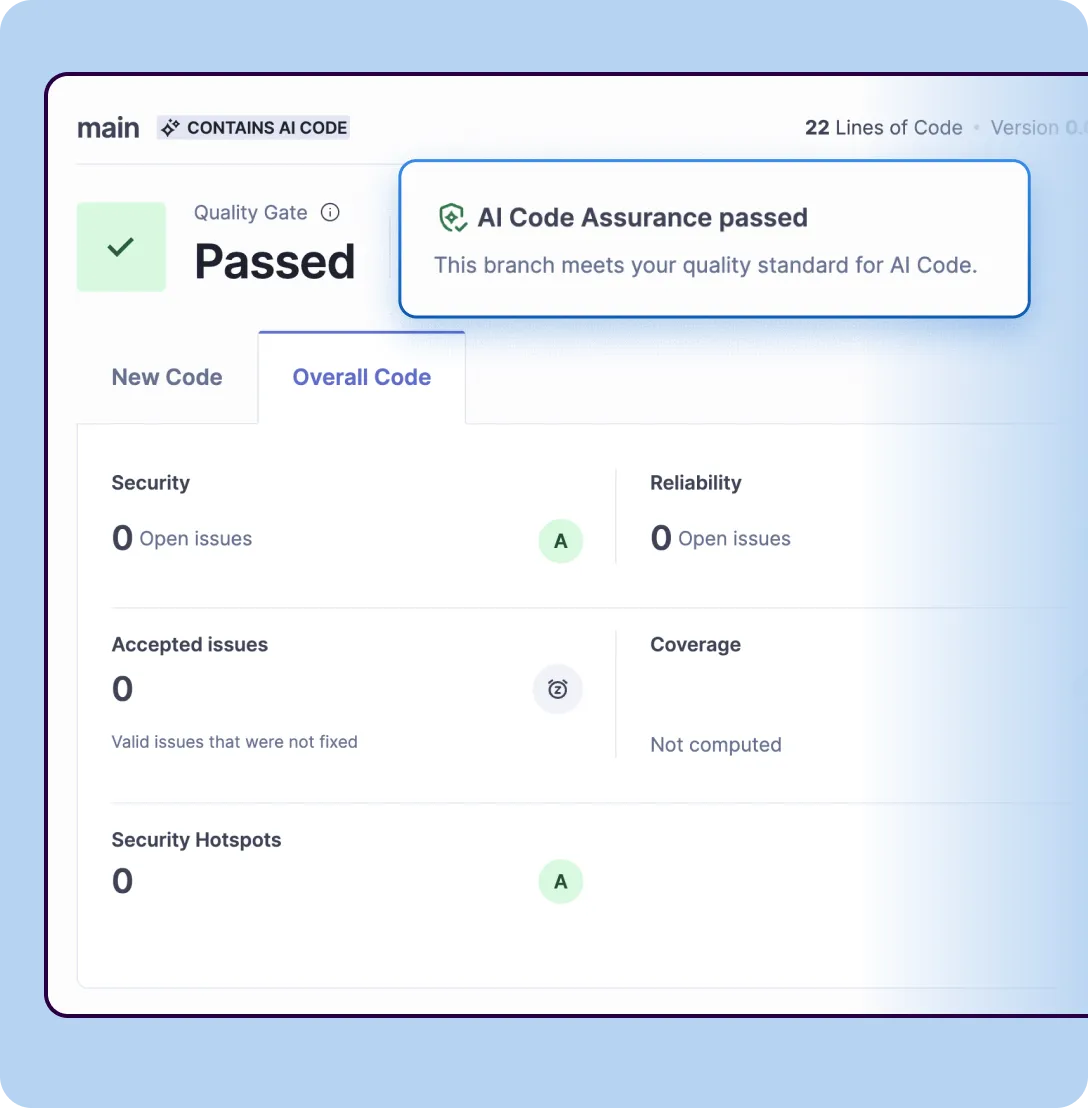
| AI Code Assurance | Flags projects containing AI code and applies an AI-specific quality gate to them | Quality gate, pull request |
| AI CodeFix | Suggests a fix for an issue; the model is selectable, even your own, including without internet access | Developer environment, SonarQube interface |
| Remediation Agent | Fixes the issue and opens a pull request; only a human will merge it | Failed quality gate, backlog |
| Hunter Agent | Looks for logic and authorisation flaws that static analysis cannot see | Main branch |
| Sonar Vortex | Guides the AI agent before it writes, and checks after it writes | Coding, inside the agent |
| MCP Server | Connects the AI agent to SonarQube; can also run in read-only mode | Coding |
The Hunter Agent, the Remediation Agent and Sonar Vortex are separate subscriptions on top of the Enterprise or Data Center edition, and they run on the bank’s own infrastructure.
Key takeaways
The talk closed with five recommendations that any development team can start on tomorrow:
- Structured use of AI: document which tools are used, for what, with what data, and who is responsible.
- Verification for every AI output: the machine checks the volume, the decision remains human.
- Have a different model do the checking: the code should not be reviewed by the same model or provider that wrote it.
- Static code analysis with AI support: independent analysis provides the foundation, and the AI capabilities build on it.
- Measure and track: re-measure the code after switching models, and keep the list of dependencies up to date.
The message of the talk in one sentence: Structure + independent verification = secure AI development – with the source code staying in-house.
Download the presentation
AI írja a kódot – de ki garantálja a biztonságát? (PDF, 2.7 MB, in Hungarian)
Sources
- Stack Overflow Developer Survey 2025 – AI
- Sonar – Sonar data reveals critical verification gap in AI coding
- Sonar – An Evaluation of OpenAI GPT-5.6 Sol & Terra
- Zhang et al. – Lightweight Yet Secure (arXiv:2601.06419)
- Spracklen et al. – We Have a Package for You! (USENIX Security 2025)
- Regulation (EU) 2022/2554 – DORA
- Commission Delegated Regulation (EU) 2024/1774
- SonarQube Advanced Security – product page
- Analyzing projects for dependencies (SCA)
- Agentic capabilities – SonarQube Server
- AI Code Assurance
- Sonar – DORA Compliance for Financial Services